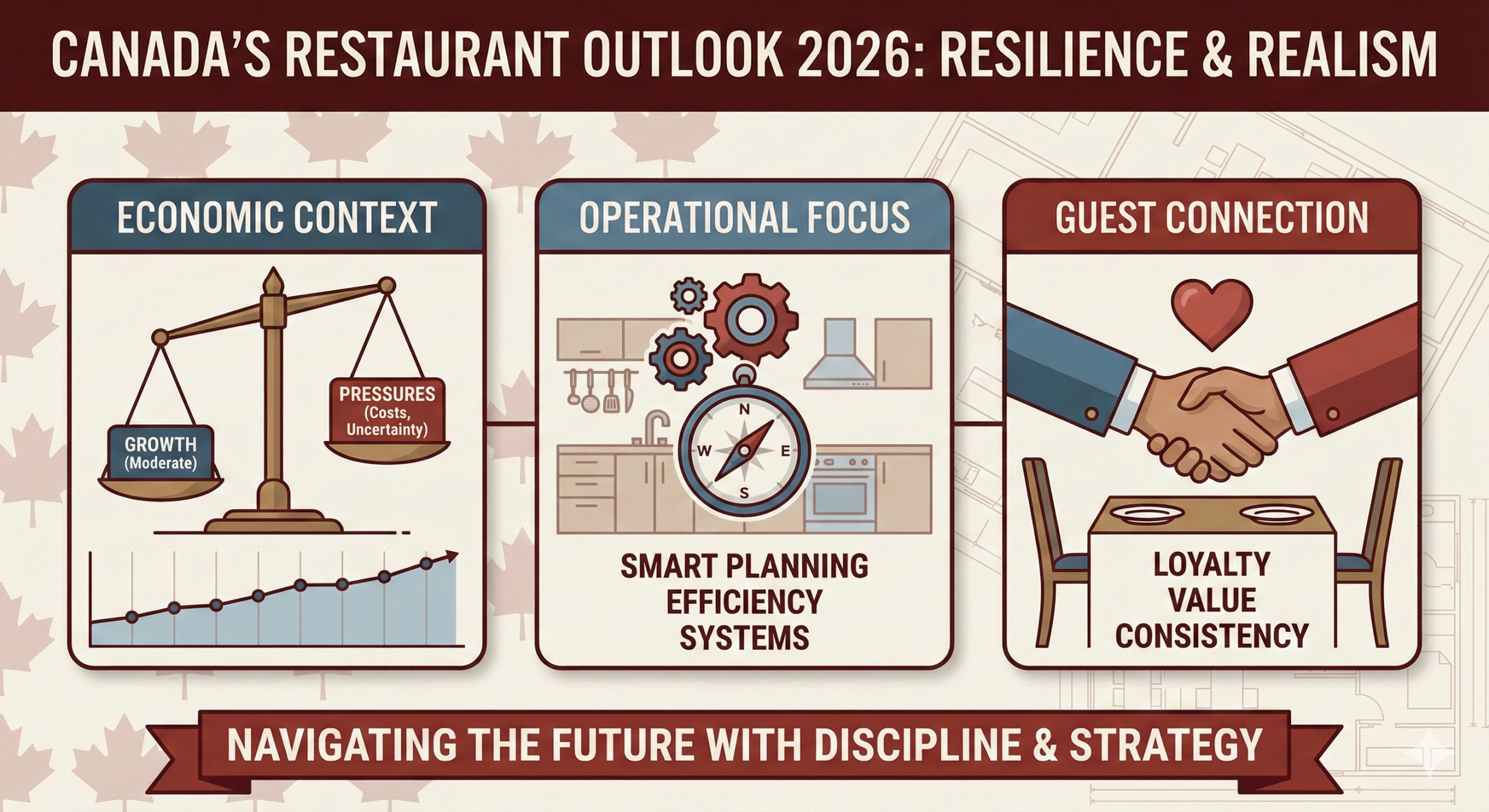
As we look ahead to 2026, many Canadian restaurant operators are preparing for a year that may resemble the last: modest growth, ongoing cost pressure, and a business environment where uncertainty still shapes decision-making. For most restaurants, the goal is not dramatic expansion. It is stability—protecting margins, retaining teams, and staying relevant to guests whose spending choices remain selective.
A Cautious Economic Backdrop
Canada’s economy is expected to remain uneven in 2026. Some customer segments will continue spending on dining and experiences, while others remain cautious and more value-driven. In that kind of environment, restaurants often see a “split” reality: strong performance in certain pockets, slower traffic in others, and more day-to-day variability.
For operators, this means planning with flexibility. A restaurant that performs well during one part of the week, season, or market cycle may still face softer periods that require discipline and consistency.
What This Means for Restaurants in Canada
In a slow-growth environment, guest expectations do not decline—if anything, they become sharper. Customers become more deliberate in where they spend. Restaurants that earn repeat visits do so by delivering predictable experiences and clear value, not by chasing constant novelty.
This is also the type of year where operational decisions matter more than marketing noise. When traffic patterns are uneven, the restaurants that stay strong are usually those that run well every day, regardless of volume.
Resilience Wins in a Slow-Growth Year
Uncertainty isn’t a signal to pause. It’s a signal to build resilience. In practice, resilience is not a single tactic— it’s a set of habits: how you plan, how you measure, how you communicate, and how consistently you execute.
1) Understand Your Local Customer Reality
Canada is not one restaurant market. A downtown core behaves differently than a suburban neighbourhood. Tourist-driven areas behave differently than office lunch corridors. Before making big changes, operators should clarify:
- Who is my primary customer: neighbourhood regulars, business traffic, tourists, or mixed?
- What days and dayparts are strongest—and which are soft?
- Are guests trading down (smaller checks, fewer add-ons), or simply visiting less often?
Clear answers help avoid wasted effort. Strategy should match the customers you actually serve, not the customers you wish you served.
2) Protect Margins Without Burning Out Your Team
Cost control remains important in Canada—food costs, occupancy, utilities, and compliance-related expenses continue to affect profitability. The most sustainable margin protection focuses on reducing waste and variability, not adding stress to staff.
- Reduce rework: fewer mistakes, fewer comps, fewer service breakdowns.
- Improve portion consistency: protect both guest experience and food cost.
- Review supplier terms and substitutions: avoid surprise cost spikes and inconsistent product quality.
3) Lean Into Operational Systems
In a modest-growth year, consistency becomes a competitive advantage. Systems reduce friction—especially during busy shifts— and help teams deliver a stable experience even when staffing or traffic patterns vary.
Simple systems that matter in 2026:
- Opening and closing routines that reduce missed steps
- Prep and station standards that keep service calm
- Clear handoffs and communication during peak hours
- A weekly review rhythm: what worked, what didn’t, what we improve next
The purpose of systems is not control. It is to help teams succeed consistently and reduce avoidable stress.
4) Strengthen Guest Loyalty Through Trust
In uncertain times, loyalty becomes more valuable. New customer acquisition can be more expensive, and casual guests may reduce frequency. Restaurants that maintain stable traffic often do so by strengthening repeat behaviour:
- Make the experience predictable—guests return when they trust what they will receive.
- Recognize regulars and reinforce connection.
- Use simple loyalty or follow-up communication to stay top-of-mind without discounting heavily.
A Practical Perspective for 2026
For Canadian operators, 2026 is unlikely to be a “breakout year” across the board. It is more likely to be a year that rewards precision: knowing your customer base, maintaining operational discipline, protecting team stability, and delivering consistent experiences that guests choose repeatedly.
Conclusion
Moderate growth and uncertainty are not reasons to lose confidence. They are reasons to operate with clarity. Restaurants that plan thoughtfully, support their teams, and deliver consistent experiences will be in the strongest position—regardless of market volatility.